
Search engine optimization (SEO) has evolved significantly over the last 15 years. With the evolution of Google’s algorithms, the divide between ‘ethical’ and ‘manipulative’ SEO has widened.
Today, SEO strategies generally fall into three main categories: White Hat SEO, Grey Hat SEO, and Black Hat SEO. All these strategies use different techniques, have different risk levels, and, of course, yield different outcomes.
Some may argue that there are appealing ways to achieve quicker rankings, but they can lead to penalties, such as traffic loss and credibility issues. You must avoid such dubious SEO techniques if you’re aiming for long-term, sustainable growth.
In this guide, you will learn the differences between white hat, grey hat, and black hat SEO. Along with this, you will learn through examples about their effectiveness. Not just that, you will also learn how to choose between white- and grey-hat SEO for sustainable, organic growth. So, let’s begin!
1. What Is White Hat SEO?
To start, white-hat SEO is an optimisation method that adheres to search engine rules and prioritises policies over algorithms. Let’s be real, gone are the days when anyone could rank higher by deceiving Google. The action against spam content and unreasonable SEO practices is unavoidable today. So, white hat SEO is considered the best practice for ranking more than ever. This type of SEO is about building authority and creating value for the website rather than trying to game the rankings.
Google is always pushing website owners to create content that is useful and created with the user perspective in mind, that meets their search intent. White hat SEO seamlessly fits that notion.
White Hat SEO is a Safe Approach!
White hat SEO helps build long-term authority, while shortcuts build short-term authority and will ultimately be lost. While it may take longer for the results to be visible, they remain more secure and will be more resistant to future algorithm changes.
Common White Hat SEO techniques
Now, let’s learn about common white-hat SEO techniques.
1. Publishing High-Quality Content
Content is still key to good SEO. To rank, one can write or generate an array of content types, such as comprehensive guides, tutorials, original research, or interesting case studies.
2. Optimizing User Experience (UX)
While it is obvious that publishing high-quality content alone isn’t enough, the website’s outlook and how smoothly it runs matter too. Google has been giving greater weight to a site’s user experience. A site owner should also check these factors. Factors like
- Fast loading speed
- Mobile responsiveness
- Easy navigation
- Secure HTTPS connections
- Logical internal linking
- Clear site architecture
A better user experience leads to higher engagement rates, which can later help boost rankings. Even if you might not see immediate results, these factors are definitely helpful for long-term sustainable growth.
3. Ethical Link Building
White hat link building seeks to gain backlinks naturally, not by buying or manipulating links. In the world of SEO, it is often seen as digital PR. One can climb the ladder by effectively writing articles for well-known sites. Guest blogging on trusted sites is definitely encouraging.
Again, Google’s AI is highly active. It won’t recommend your content if it isn’t based on original studies. Your content could or should include a resource page and shareable content. With that, let’s not forget that it is always about quality, not quantity.
2. What is Black Hat SEO?
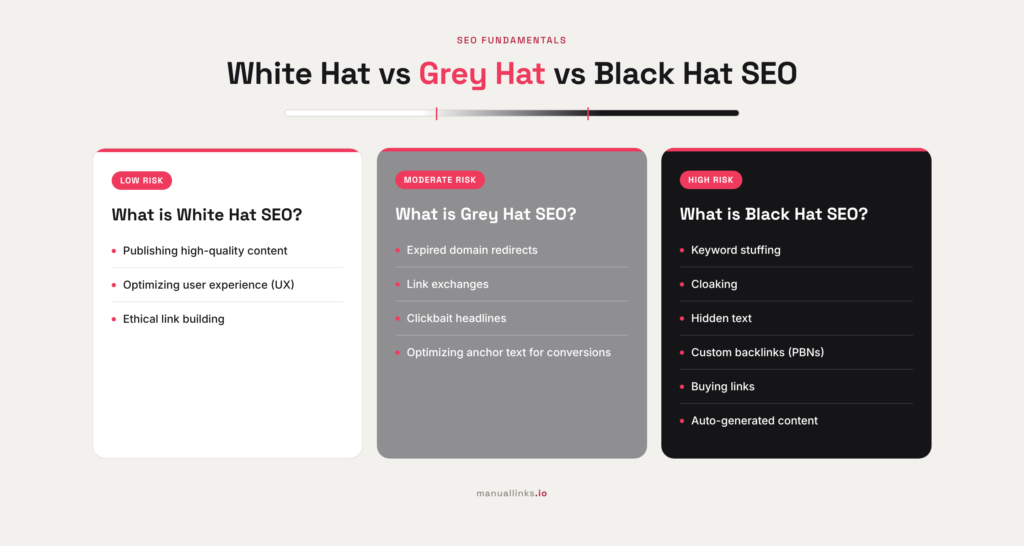
As the name suggests, it is the opposite of white hat SEO. Black Hat SEO is the intentional use of SEO practices that violate search engine guidelines to gain higher rankings.
Black-hat techniques aim to exploit flaws in ranking algorithms rather than enhance content or user experience.
Some “black hat” tactics might be effective in the short term, but have very high risk. After being found, websites can suffer from a huge drop in ranking, manual penalties, or even be banned from Google’s search index.
The most widely used black hat SEO methods are:
3. Keyword Stuffing
When the same keyword is used too many times to manipulate rankings.
Example:
The SEO agency in London is the best, offering SEO services.
This can lead to poor user experiences and violates Google’s quality guidelines.
4. Cloaking
Cloaking is displaying different information to search engines than to users.
For example:
Googlebot views an informative article.
Redirects the user to another sales page or to a completely different website.
It’s one of Google’s biggest offenses.
5. Hidden Text
Some websites make use of the following methods to conceal keywords:
Prints white-on-white to prevent glare. Prints white-on-white to avoid glare.
- Tiny font sizes
- CSS tricks
- The content is not for human consumption, but for search engines.
4. Custom Backlinks
PBNs are comprised of numerous sites owned by a single person and created solely to pass link juice. They can temporarily boost rankings, but Google has become more adept at detecting them over time.
5. Buying Links
It is against Google’s guidelines to buy links that carry 100% of the PageRank.
Examples include:
- Deceptive guest posts: Paid guest posts without disclosing the connection.
- Sponsored links that are not properly attributed.
- Link marketplaces
6. Auto-Generated Content
This is obvious: it’s either a failure or only a short-term success. When website owners talk about ‘AI’ content, this is what they actually mean. Auto-generated content is another black hat technique to create pages using AI or software that have little to no value.
It is not the AI technology itself that is the issue; rather, it is that the AI generates thin, spammy, and unedited articles designed to game the system. The issue is not AI itself; it’s the thin, unedited, and spammy articles generated by AI to “game the system”.
3. What is Grey Hat SEO
Grey Hat SEO is situated between white hat and black hat SEO. These methods don’t clearly breach search engine rules, yet they work around the obscurity or malfunctions of such rules.
Grey hat techniques can provide quicker results than white hat techniques but carry much higher risk.
Many methods that were once considered “grey” are now being labeled “black hat” as Google’s algorithms change.
Common Grey Hat SEO Techniques
Some well-known Grey Hat SEO techniques by which you can know the website is utilizing this type of SEO are:
1. Expired Domain Redirects
Some marketers use expired websites with high backlinks and transfer them to new websites.
The strategy could create a temporary transfer of power if the topics are similar.
But Google is paying less and less attention to irrelevant redirects nowadays—or, in fact, punishes them.
2. Link Exchanges
Two websites enter into a mutual agreement to exchange backlinks.
Natural exchanges can occur on occasion and may be legitimate.
However, large-scale reciprocal linking can seem “manipulative”.
3. Clickbait Headlines
Headlines that are used solely to drive traffic, not to convey accurate content. Examples include titles such as: “The biggest SEO secret that Google has revealed”.
When it relies on typical optimization tips and tricks, one problem arises: high bounce rates can negatively affect long-term effectiveness.
4. Optimizing anchor text for conversions.
Over-optimizing with backlinks containing the “exact match” of your keywords, but not in a way that looks like they’re spammed.
This trick can be used for a while without being noticed and, over time, can become hazardous.
Conclusion
In a competitive landscape, White Hat SEO is the most effective and future-proof approach for ensuring sustainability, credibility, and steady growth. It’s in line with search engine guidelines, sustainable, and can continue to deliver results years after any quick fixes.




2 Comments