White label link building services provide agencies with a means to sell the links under their own brand without developing the outreach, publisher relationships, creation, and delivery systems internally. This is no longer an option in 2026. It is a working operating model for agencies that require predictability in fulfilment, managed margins, and a more streamlined approach to scaling SEO deliverables.
The market is no longer the same. DR-only placements have already ceased to be the safest, and providers that base their offerings on thin sites, low editorial quality, or exaggerated metrics are far more dangerous than they were several years ago.
The most competitive providers now emphasise actual traffic, topicality, the quality of editorial placement, and clean reporting. Pricing has changed with that shift as well. The wholesale average across agencies is now generally between $180 and $300 per link. At the same time, freelancer offers may range from $60 to $150, and premium placements may range from $450 to $700, depending on the site and niche.
For business owners and SEO agencies, the question is no longer whether white-label link building works; it’s whether it works for them. The real question is how to buy it profitably, how to quality-check it, and how to resell it without creating risk.
| Quick answer | White label link building services means paying a specialist provider to build backlinks that get delivered and reported under your agency’s own brand — the client never sees the provider’s name. |
| Typical wholesale cost | $180–$300 per link for mid-tier placements; $60–$150 from freelancers; $450–$700+ for premium editorial coverage. |
| Standard markup | Most agencies resell at roughly 2x wholesale, targeting a 30–50% gross margin across the program. |
| Time to results | Indexing in 7–30 days; measurable ranking movement in 60–90 days; compounding impact in 3–12 months. |
What is White Label Link Building Services
White label link building refers to a third-party provider creating the backlinks on behalf of your agency, but the end client can only view your agency’s name. The provider remains behind the scenes. Their prospecting, outreach, content, placement, and reporting are managed, and the client relationship and ultimate pricing are left in your hands.
This is unlike typical outsourcing, as branding is included in the service. The provider operates under your brand, with typical NDAs and non-disclosure agreements, ensuring a seamless client experience. That is the agency’s call: you can increase what you offer, without having to employ a complete outreach team or create a publisher network out of thin air.
The most appropriate white-label deals are not only invisible; they are also invisible. They are structured. Fully defined quality thresholds, authorized anchor text policies, reporting templates, and replacement policies should also be expected in the event of a drop or loss of dofollow status for a placement.
White Label vs. In-House Link Building
Before committing budget either way, it helps to see the two models side by side.
| Factor | In-House Team | White Label Provider |
| Cost structure | Fixed — salaries for outreach, editorial, and account staff | Variable — pay per link or per campaign |
| Scalability | Limited by headcount | Scales with demand, no new hires needed |
| Control | Full control over strategy and execution | You approve placements; execution is external |
| Speed to launch | Months to build publisher relationships | Days to weeks — network already exists |
| Risk | Bounded by your own team’s skill | Depends entirely on vetting the right partner |
Neither model is universally better. In-house buys tighter strategic integration; white label buys speed and margin flexibility. Most agencies managing three or more link-building clients at once find in-house delivery starts to stretch thin well before that point.
Why Agencies Use White Label Link Building services in 2026
Agencies adopt white-label fulfillment because it links fixed overhead to variable costs. The agency does not have to pay outreach staff, editors, and publisher manager salaries; instead, it purchases links on demand and sells them at a premium.
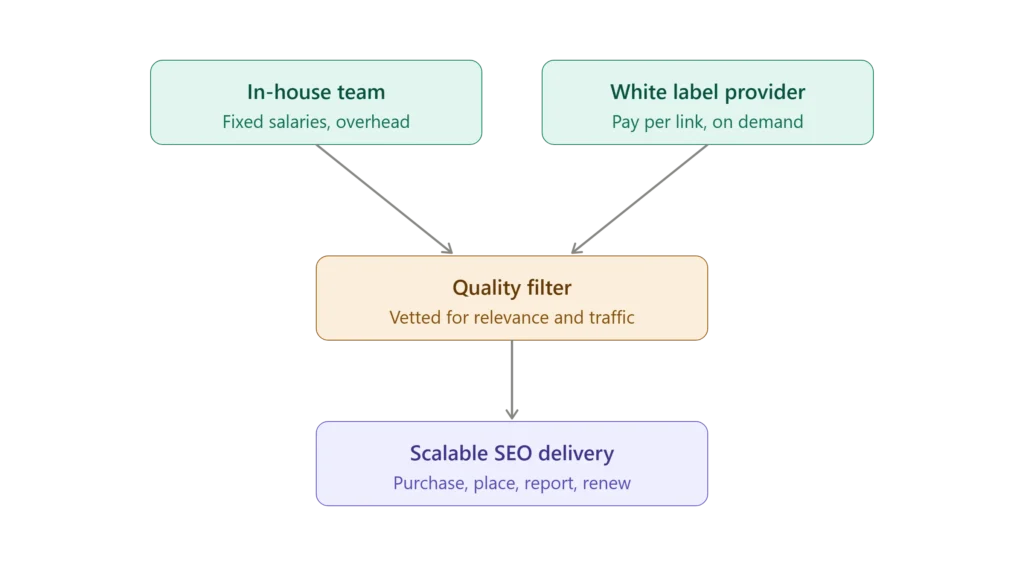
This is important in 2026, as most clients desire measurable, scalable SEO, not unspecified deliverables. White-label link building allows agencies to keep it simple: purchase links, place links, report links, and renew campaigns.
The other reason is quality control. The current spam problem and Google’s development of AI-generated content have driven the market toward a more discriminating placement criterion. A low-cost provider that may have been good in 2024 could now do cleanup jobs in the future. Agencies that select providers based on traffic, relevance, and editorial principles are much better off.
The Actual Pricing Ranges in 2026
The error that many agencies commit is in pricing. They pay too much to place an advert that isn’t worth the price, or they underprice clients, killing the margin.
The following is the realistic pricing scenario in 2026:
Sourcing by freelancers or solo operators is around 60-150 USD per link. These connections are suitable for small tests or campaigns with lower budgets, but they are less consistent and require more supervision. For the fuller pricing picture across every acquisition model — not just white label — see our 2026 link building pricing guide.
The average white-label provider in the middle tier usually charges between $180 and $ 300 per link. This is the best value area for most agencies, as placements are typically based on sites with actual traffic, acceptable authority, and editorial content use.
The high-end placements can cost $450 to $ 700 or more per link. They are typically used for stronger publications, more competitive industries, or brands that require higher-end editorial coverage.
Wholesale band is usually the most stable, at 180-300 USD per link, which is most suitable when agencies are buying in large quantities. It is in that market that the market has pegged its quality-oriented campaigns. Very low-cost links may look appealing on paper, but when you factor in account management, revisions, QA, and reporting, the actual internal cost quickly increases.
The rule of thumb in 2026 is to plan the budget to fund the link itself and the time to validate it. An agency can easily spend over $200 in internal time to create a link that costs a lot of money in follow-up, editing, and rechecking. A high headline price does not necessarily imply a high real cost.
What Kind of Links are being sold by White-label providers?
Most white-label providers offer several formats.
Guest posts are still not uncommon. These are fresh articles published on the pertinent sites with a contextual connection within the article. They are effective in situations where the client requires content and authority cues.
Contextual insertions, also known as niche edits, insert a link into an already published article. They are quicker and may be less costly than complete guest posts.
Digital PR and editorial mentions are more upscale placements in well-known publications or news-type coverage. These are better suited to enterprise brands or high-stakes niches.
Local citations and resource page links are suitable for local companies and smaller service companies. They do not equate to premium editorial links; however, they can still be helpful to a larger link profile.
HARO-style journalist sourcing is another format worth asking about: your client gets quoted as an expert source in a journalist’s article, and the resulting link carries strong trust signals because it’s editorially earned rather than purchased outright.
The appropriate format often varies depending on the client’s case. An established field within a competitive niche will usually require more editorial links. A local company can derive greater value from a combination of citations, locally relevant placements, and strong contextual linking.
Common White-Label Link Building Scams to Avoid
Quality control is the single biggest risk in white-label fulfilment, because the links a provider generates directly determine whether the campaign helps or quietly damages a client’s site. A few patterns show up again and again:
| Scam Pattern | What It Looks Like |
| Private Blog Networks (PBNs) | Networks of sites built solely to sell links — high risk of mass de-indexing |
| Link farms | Sites that host any link for anyone, with no editorial standard |
| Directory, comment, and forum spam | Technically not harmful, but near-zero ranking impact for the price paid |
| Fake guest post services | Placements on the same low-value PBN and link-farm inventory, repackaged as “guest posts” |
| Unproven providers | Big promises, no verifiable case studies, live examples, or client references |
For the fuller picture of which tactics are safe, risky, or outright against Google’s guidelines, see our breakdown of white hat vs. grey hat vs. black hat SEO.
What Agencies Should Look For in a Provider
It does not necessarily have the loudest promises that make it the best white-label provider. It is the one that can prove quality.
A good provider like Manual Links shows actual organic traffic on the sites they operate, not domain rating. Both DR and DA are effective screening measures; however, neither is a Google metric, and neither provides the complete picture. By 2026, traffic will be a better indicator of a site’s audience value.
They are also expected to show topicality, spam scores, and editorialism. If the provider is unable to provide details on how their publisher list is audited, it indicates the publisher list is not audited.
An excellent provider should also offer a replacement policy. In case of a link drop or de-indexing, or a change in dofollow status within a specified time frame, it must be replaced without any charges. The no-replacement policy imposes the entire risk on your agency.
Another must-have would be control over anchor text. Your agency should accept anchor guidelines. When a provider is too pushy with exact-match anchors, it becomes a backlink danger — see our guide to natural anchor text distribution for the ratios a healthy profile should stay within.
| Checklist Item | Why It Matters |
| Real organic traffic (1,000+ monthly visitors minimum) | DR and DA aren’t Google metrics — traffic proves an actual audience exists |
| Pre-approval on every target site | A provider unwilling to let you review sites first is selling from a fixed, low-quality list |
| Healthy outbound-to-inbound link ratio | Too many outbound links on a site is a link-farm signal |
| Topical relevance over raw DR | A DR 50 site in the right niche outperforms a DR 80 site in an unrelated one |
| Anchor text control | You should set the guidelines, not the provider |
| Written replacement policy | Links drop or get de-indexed — a real guarantee protects your margin |
| Delivery documentation | Live URL, target URL, anchor used, publish date, and source metrics per link |
Lastly, the provider must provide usable documentation of delivery: the live URL, the target URL, the anchor text used, the publication date, and simple quality measures for the source site.
The White-Label Fulfilment Process, Step by Step
Whichever manual link building provider you choose, the fulfilment process behind a healthy campaign generally follows the same six stages:
You specify the link type and volume, and which target pages should receive them — or the provider helps identify the best candidates.
The provider reviews the client’s site, competitors, and existing content assets to spot the strongest link-earning opportunities.
A plan is built around the fastest path to quality links — usually a mix of guest posts, editorial links, and linkable assets, depending on the niche.
A list of relevant sites is built and personalized outreach goes out, making the case for why the placement is worth the publisher’s time.
Real negotiation with the site owner — not a templated blast — to land a placement that benefits both sides.
Live links are tracked and handed over in a white-label report with the live URL, target page, anchor text, and source metrics.
The Agencies should price the Service as follows.
The easiest one is the most basic: charge 2x of the wholesale price. This only works if you’re actually buying at a fair wholesale rate to begin with — see our guide on buying backlinks the safe way for how to vet that price against the market.
A normal and sustainable model is to sell a link you purchased for $250 at $500. Those are not the only markups that are covering the link. It also covers strategy, account management, QA, and reporting. The majority of the agencies aim to achieve a gross margin of 30-50% on the entire program rather than a raw link cost gross margin.
One-off campaigns can be best achieved through a project-based model. A retainer model is more effective when the client wants a monthly link flow. Value-based pricing may also apply to larger enterprise accounts, where the fee is based on ranking or traffic performance rather than merely the number of links.
For most agencies, per-link pricing is the easiest to sell. It is clear, easy to understand, and delivered monthly.
Time to see Results
Under-setting the expectations is one of the largest errors that agencies make. The standard indexing time for white-label links is 7-30 days. When movement is to be measured, it usually becomes a measurable aspect within 60-90 days.
The effects of stronger compounds appear within 3 to 6 months. For competitive keywords, it can take 6 to 12 months for the full impact to be realized.
That is, link building must be marketed as a compounding asset rather than a quick fix. Much easier to retain clients who realize that. Clients who hope for a miracle within 30 days tend to cancel prematurely.
Properly Reporting Results
One of the most distinguishing features of white-label fulfillment is strong reporting. An effective report must include live URLs, target pages, anchor text, source domain metrics, and publication date. But the most favorable reports go a step further. They indicate expanding domains over time, keyword movement on the connected pages, referral traffic, and any conversions that can reasonably be attributed to the campaign.
Anchor diversity should also be monitored. The typical mix of branded anchors (35 to 45), naked URLs (15 to 20), generic anchors (10 to 15), partial-match anchors (15 to 20), and exact-match anchors (5 to 10) in a natural backlink profile in 2026 would be as follows:
The link’s speed is important as well. The gradual, slow growth trend is less risky than a steep curve followed by nothing. The agencies must not exhibit unnatural bursts that appear artificial.
Aggressive Strategy or Quality?
The past mentality was to get as many links as possible. Such a method is outdated. The quality floor is increased in 2026. The risk, rather than the value, is created by sites with no actual organic traffic, poor editorial standards, or a pay-for-placement footprint. A few good, meaningful placements can be better than a large number of bad ones.
That is why agencies need to consider the accumulation of authority rather than monthly volume. Each good link adds to the client’s long-term asset base. It is not only for sending links. It aims to establish a profile of links that will facilitate long-term rankings, trust, and conversions.
Who is White Label Link Building ideal for?
This service is most powerful for SEO agencies that prefer to scale fulfillment without hiring extensively. It can also be very effective with consultants who sell strategy but do not desire to expand.
- You’re managing three or more link-building clients at once and in-house delivery is starting to stretch thin
- You’re entering a niche where you have no existing publisher relationships
- You want to offer link building without hiring and training a dedicated team
- New client wins are outpacing your current fulfilment capacity
- You need consistent monthly output without capacity limits
It would also apply to business owners, particularly those who recognize that link building is a component of an overall SEO framework. The model is most effective when the buyer prefers consistency, documentation, and measurable quality standards.
It will not be appropriate for those with a short-term horizon, unlimited capacity, or assured positions. None of the valid providers should be responsible for that.
FAQs
Final Takeaway
The concept of white-label link building in 2026 is no mere add-on of a reseller. The finest providers operate real websites, real traffic, editorial requirements, open reporting, and substitution assurances. The most effective agencies will not consider it a low-cost commodity but rather a service that is managed on a case-by-case basis and on a margin.
To most businesses and SEO agencies, the sweet spot is evident: purchase at a wholesale price of between 180 and 300, resell at a clean 2x markup, secure a 30 to 50 percent gross margin, and measure success by traffic, position, and client retention as opposed to the amount of links purchased.
That is what makes the difference between a link service that merely fills in a deliverable sheet and a white-label system, which really serves a link building agency to grow.