
Allow us to make a guess: you launched a website some time ago, but it appears you are not achieving the results you anticipated. You are much behind your competitors, and it seems too hard to beat them. Sounds relatable?
Well, let us put this straightforwardly: your competitors aren’t specially favoured by search engines, nor are they purely lucky; instead, they are strategically pushing their websites by buying high quality backlinks, sought-after, relevant website link placements combined with advanced search engine optimization, which allows them to rank significantly higher than you. But how are they doing it? The answer is through link building. You might already know about link building.
Link building is often divided into two types: Manual and Automatic. If you want to compete seriously with your competitors, Manual link building is a solid way to do so. In this post, we will guide you through everything you need to know about Manual Link Building and show you how it makes a difference.
What is Manual Link Building?
Manual link building is the process of getting links through real people outreach, rather than automated methods, mass email blasts, or bad links. To seriously compete with your competitors for the long term, you need to invest equal time and effort, besides money, to carefully select which sites fit precisely in your niche criteria to leverage your brand.
Basically, it’s about identifying relevant sites, building a natural relationship with the site owner or editor, and getting a backlink from their site, whether by creating content, co-creating content, or being featured in their editorial.
If you are looking for long-term search visibility, manual link building is important because it produces high-quality, relevant, and trustworthy links. Just a handful of good-quality links from legitimate sites will do more than a ton of mediocre links from a myriad of unrelated sites. Therefore, link building is one of the best white-hat SEO tactics in 2026 that can be done manually.
This is a slower way to build links, but it is also safer, more sustainable, and better aligned with what Search Engines consider authority these days. When it comes to lasting rankings, it may make more sense to go the manual route.
Why Manual Link is a Much Better Approach
Backlinks are one of the most significant indicators of trust to search engines. Any link from a reputable site pointing to your site indicates that you have content that is helpful, relevant, and interesting to users, and therefore, search engines are likely to show it to users. However, not all links are created equal.
Backlinks from a trusted source website are of much greater value than those from a random website on a different site. This is where link building comes in handy. It is not about chasing volumes; it’s about picking websites, topics, and placement.
Manual link building is important because you can:
- Develop credibility and set up links.
- Optimize which keywords they rank for. Refine their rankings on keywords that they are competing for.
- Increase your website’s trust signals. Improve your website’s trust signals.
- Get traffic to their site from helpful locations.
- Try not to incur penalties for spamming or other manipulative practices.
The worth of “getting links” is not only for companies. The real goal is to get links that will help build your brand’s credibility and long-term organic growth.
How Manual Link Building Works
Manual Link Building is a human-driven link building. If you require quality, then there is no quick cut. The process is typically simple but requires attention and discretion.
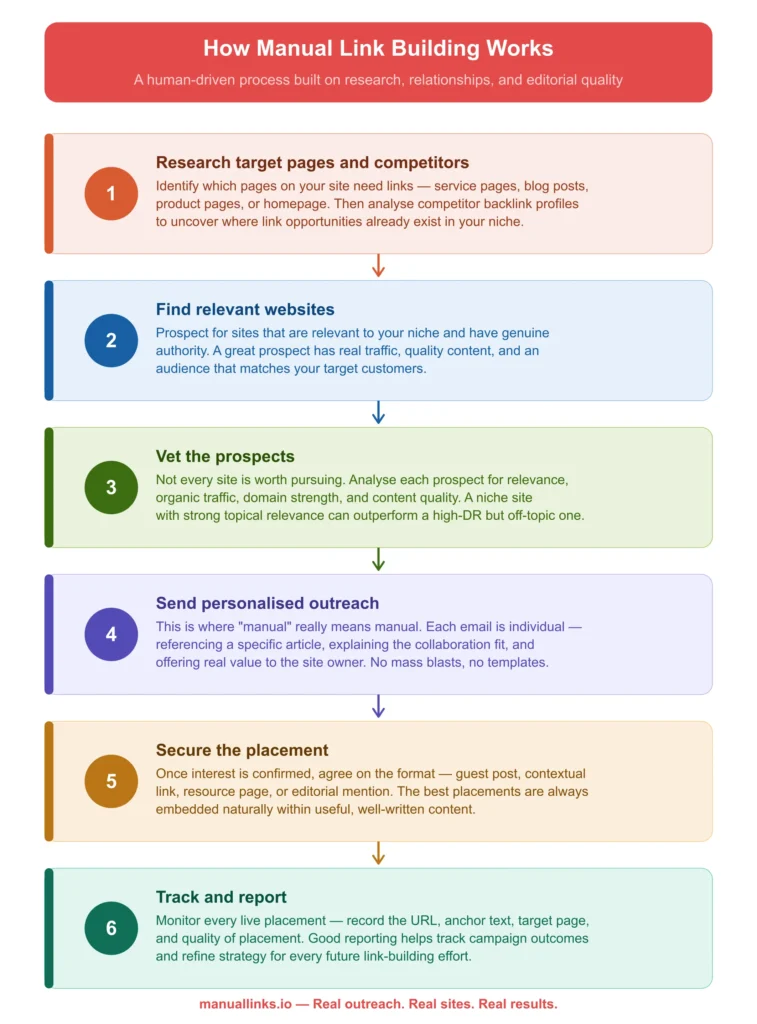
1. Research the target Pages and competitors.
The first step in the process is to determine what pages you want to link to on your site. This can be a service page, blog post, product page, or home page. The next step is to check out what your competitors are doing.
If there are strong competitors in your niche that already have links from the same types of websites, then you have an idea of where the opportunities in your niche may lie.
2. Find Relevant Websites
Next comes prospecting. This will involve searching for sites relevant to your niche that have the authority you’re looking for. A great prospect is normally a site that currently gets traffic, has content, and has an audience targeted to your business.
Replicating your competitors’ backlink profiles gives you a clear indication of whether it is also a good strategy for you or not. If your competitor is dominating the SERP, it means you should consider replicating their approach; otherwise, you may not need to pursue it.
3. Vet the Prospects
Not all sites are worth going to. Good manual link builders will conduct a detailed analysis of the metrics, including relevance, organic traffic, domain strength, and content quality, before reaching out.
A niche site with strong topical relevance and traffic could be more beneficial than a high-traffic, high-authority site with no real traffic.
4. Send Personalized Outreach
This is where manual link building really gets “manual.” The outreach is individual, not mass. The outreach is targeted to individual websites, rather than hundreds or thousands of websites.
The e-mail typically refers to a specific article, explains why the collaboration is a good fit, and provides a benefit to the site owner.
5. Secure the Placement
Once you have decided that the site owner is interested, the next step is to determine how you will embed the link. It can be a guest post, a contextual link, a resource page link, or an editorial piece. Naturally, the best links are those embedded in useful content.
6. Track and Report
After the link is operational, it must be monitored. Some of the elements that make a good report include the live URL, anchor text, target page, and quality of placement.
This will help track the campaign’s outcomes and adjust going forward.
Manual Link Building vs Automated Link Building
The biggest difference between manual and automated link building is control.
Automated link building attempts to build lots of links as fast as possible. Typically relies on templates, software, bulk prospecting, and/or spammy networks. It can produce many links in a short time; these links aren’t necessarily high-quality or relevant, and may be dangerous.
Manual Link Building takes time, but it will be more reliable. It provides greater control over the source of links, the context surrounding them, and the feel of their placement.
Typical manual link building will provide you with:
- Better relevance
- Stronger editorial quality
- Reduce the chances of penalties. Minimize the potential for penalties.
- The anchor text used is more natural.
- Better long-term value
Link building automation can result in:
- Irrelevant placements
- Duplicate outreach
- Poorly designed websites or websites with spam.
- Over-optimized anchors
- Short-lived results
In SEO, it’s not all about speed. Typically, the general stability and trust are more important.
Types of Manual Link Building Strategies
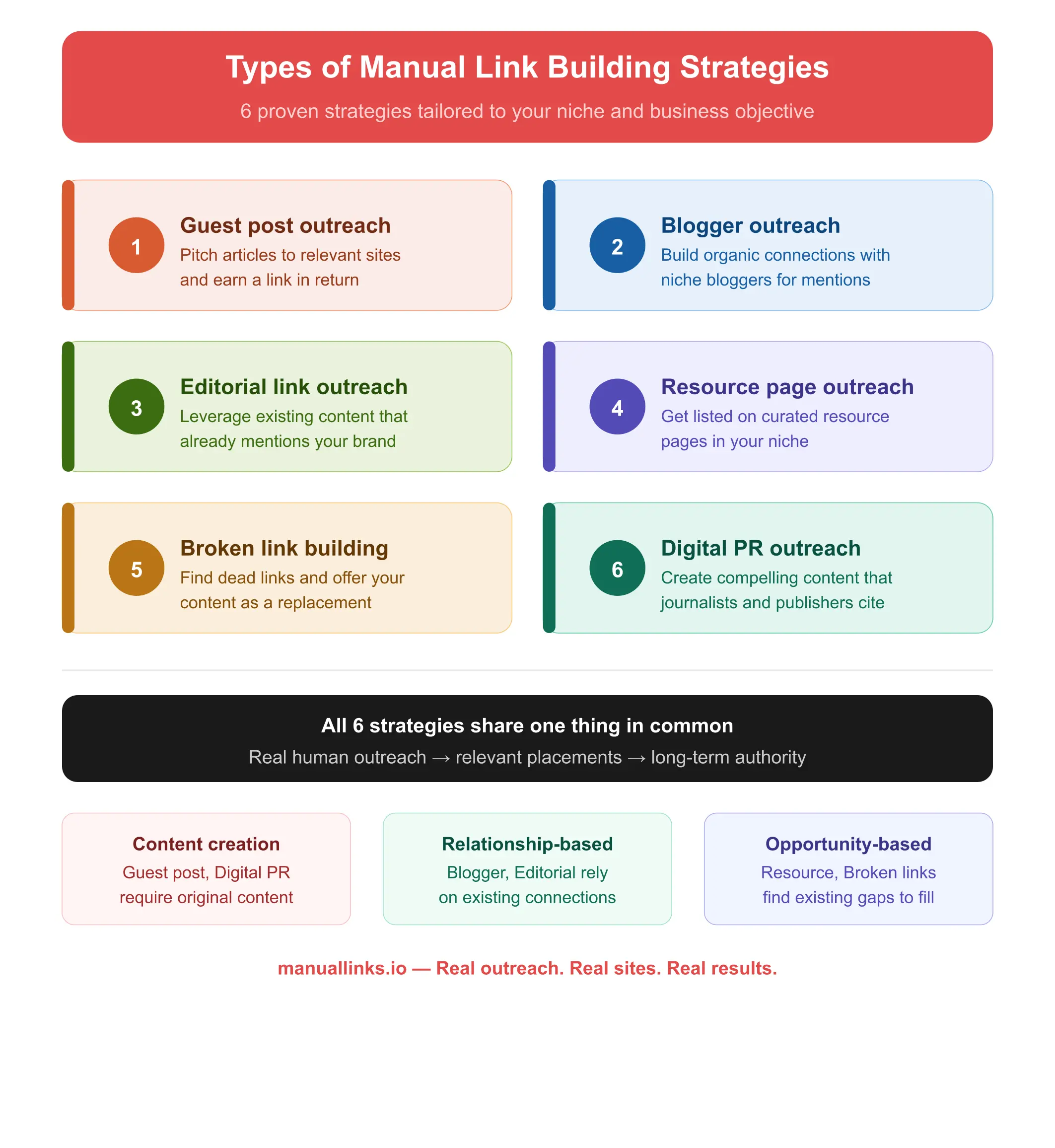
There are no set steps to manual link building. It incorporates a range of strategies tailored to the website, niche, and business objective.
1. Guest post Outreach
This is one of the most popular manual link-building techniques. You reach out to the appropriate sites and propose to write a worthwhile article for their readers.
In return, you’ll get a link back within the article or the author’s bio.
2. Blogger Outreach
This includes contacting bloggers in your niche and building organic connections with them.
It could be a mention, a review, a resource, an incorporation, or a contextual connection.
3. Editorial link Outreach
This technique leverages the content or data of an article that is already in progress or has been updated, and that mentions your brand, data, or content.
These are usually very natural because they are placed within the existing editorial content.
4. Resource Page Outreach
A few websites have resource pages that help to display helpful resources, services, or articles.
Including it would be a good idea if your content is useful to the audience it’s for.
5. Broken Link Building
The idea is to discover broken links on relevant websites and recommend your site. It’s useful because you’re helping the website owner correct something while earning a backlink.
6. Style of Digital PR Outreach
This is a more in-depth type of manual link building.
It aims to develop a compelling piece of content, data, or insight that journalists and publishers may cite.
What Makes a Good Manual Link?
Not all of the backlinks are created equal. A good manual link typically will have the following features:
- It is taken from a real website with a real audience!
- It is relevant to the niche you are targeting and its theme.
- It’s displayed in helpful, readable information.
- It feels “normal”, not pushy, not “over the top”, and not “overdressed”.
- Uses anchor text that is appropriate for the page
- Originates from a reliable and active domain
Not all of the best manual links are “SEO links.” They are also sensitive to the reader. Part of the reason they are more long-lasting is that.
While Achieving Manual Link Building: Quality Over Quantity
There is a common misconception among many people that the more links they have to their site, the better they will rank. That’s seldom the case.
One quality, a relevant link from a good, authoritative web page can be worth more than 10 poor links from low-quality blogs. Modern search engines have evolved in their ability to comprehend context, topical relevance, and authority signals. That means that quality is more important than quantity.
This is why it is just as important to do manual link-building campaigns based on fewer but better placements. It’s not about how many links you can have. The goal is to create a doable backlink profile that’s natural, authoritative, and trusted.
There are numerous common mistakes in manual link building. Several common mistakes in manual link building.
Any manual link-building effort can fail if done the wrong way. Some of the more frequent errors are:
Avoid Targeting irrelevant websites BY:
- If the anchor text is overly optimized, it will be considered spam.
- Selecting fake authorities (FA) for the sites.
- Outreach emails are sent as mass emails. Outreach emails are sent as a mass email.
- Arguably, the wrong approach to improving link count is to prioritize link count over link quality.
- Not taking the audience at the target website into account
- Not keeping monitor records of live placements
The worst blunder is to look for easy solutions. If the strategy seems too simple and/or too inexpensive, chances are the links won’t be particularly valuable.
Google’s View on Manual Link Building
Search engines aren’t against the backlinks. Indeed, backlinks are among the best ranking factors. Search engines don’t like manipulative actions.
There is a time and place for manual link building, and in that context, it’s safe as long as it’s done in a natural, editorial, and relevant manner. That implies the link is acquired, not acquired through spam or deceptive strategies.
Manual link building can fall under the category of white hat SEO when it’s sincere outreach, and the placement makes sense for the page in question. It is important to keep things relevant, useful, and on the editor’s level.
How many backlinks should I build?
This is a very common question in the minds of founders and CEOs. When investing money in the backlink-building process, they are often unsure about how many quality backlinks they should generate.
Some say “as many as possible,” while others suggest “fewer but high-quality links.” However, the reality is different.
For example, if your authoritative competitors have only 500 quality backlinks and you suddenly create 5,000, it may send a red signal to search engines because Google could interpret it as an attempt to manipulate its algorithm. As a result, your site may be affected or even penalized.
The best practice is to analyze how many backlinks your top competitors have built and use that as your target. Aim to match them—not significantly less or more—to stay on the safe side.
How AI is impacting Manual link building?
AI is impacting workflows, but it’s not replacing good old human judgment. Here are some of the areas where AI can assist with prospect research, email writing, topic ideas, and outreach organization in 2026:
For 2026,
AI can aid in prospect research, crafting emails, generating topic ideas, and organizing outreach. That can save time. However, AI is not meant to replace manual link building; rather, it complements it.
The human element is still important, as judgment is necessary in link building. A tool is available to help identify a list of sites. Still, it can’t make a complete determination of a brand’s tone, the editorial fit of a placement, or the quality of the relationship.
This is why it’s still important to have people review, refine, and approve all opportunities in the best campaigns.
AI can help to accelerate it. It can’t create low-quality, valuable links.
Manual Link Building and AEO/GEO.
AEO and GEO are part of the new search landscape, where manual link building is also relevant. Answer Engine Optimization (AEO) is the process of optimizing content so answer engines and AI-powered search tools can more easily reference it.
Generative Engine Optimization (GEO) is a concept for improving the prominence of content in the answers generated by artificial intelligence.
In reality, it’s still a good idea to have strong backlinks. Backlinks from reputable sites boost the indication that search engines and AI systems give your content.
This implies that if your content is seen as relevant and useful by the search engine, it can also appear in AI-generated results, alongside traditional search results. The best thing to do is to continue the same process – get links from real websites on your topic.
What are the expenses for Manual Link Building?
Manual link building costs will vary depending on placement, the site’s authority (DA), and the fact that lower-tier required sites are less expensive and typically weaker. The higher the quality of placement, the more expensive it will be, as they must do more research, outreach, negotiation, and content creation.
We’ve already written a detailed article on link building costs.
Overall, the manual link-building prices are one of three types:
- Per-link pricing
- Monthly retainers
- Package-based campaigns
For one-off placements, per-link pricing is easy to use and prevalent. If you have an ongoing SEO campaign that requires regular link acquisition, it is better to opt for a monthly retainer. If your business requires a specific number of links within a specific time, packages are the option for you.
The focus should be on more than the cost. It’s the significance of the placement in relation to your objectives. You can have a lower budget without it being problematic if it is applied at the right kind of sites.
Manual Link Building is Time-Tested
Manual Link Building is still a worthwhile strategy as it is a time-tested approach that has been used for years.
Despite other methods, manual link building remains the strongest. The benefits are likely to be greater and more lasting, but not as easy to achieve.
This is beneficial for business owners, leading to improved long-term rankings and greater confidence. It means a safer service for SEO agencies to offer, with quality guidelines established. For both, the chance that the search algorithms will change and, consequently, break the link profile is reduced.
Manual link building is not just an SEO strategy; when done correctly, it’s a strategy. It’s all about establishing online credibility.
Conclusion
To put it in the best way to understand, the process of deliberate research, outreach, and editorial value is known as manual link building. It takes longer than automation, but it is much more effective in the long term, and is certainly much safer.
For any manual link-building campaign, the three components of relevance, quality, and trust are important. They do not take shortcuts, do not end up in spam, and try to make logical placements for the reader. It is this that makes them function.
If you’re striving for long-term authority, link building remains one of the best options. Where businesses seek a hands-on, quality approach, Manuallinks.io has been created with that very concept: genuine outreach, genuine sites, and links built to support long-term SEO growth.

2 Comments