
Search engines no longer evaluate backlinks one by one. Instead, they analyze the overall pattern of your link profile to determine whether your website has earned links naturally or manipulated them. A single instance of a keyword anchor is unlikely to trigger a penalty — but a whole backlink profile stuffed with keyword anchors certainly can.
This guide explains what anchor text distribution is, what a healthy backlink profile looks like, and the practical steps you can take to keep your anchor ratios aligned with Google’s expectations.
What Is Anchor Text Distribution?
Anchor text distribution is the percentage breakdown of different anchor text types — branded, generic, URL, partial-match, and exact-match — pointing to a page or an entire website.
Google doesn’t analyze each link in isolation; it looks at the overall profile. A natural distribution includes a variety of branded anchors, naked URLs, generic phrases, partial-match keywords, and only a small share of exact-match commercial keywords. This holistic approach lets Google’s systems distinguish between organically earned backlinks and manipulative link-building campaigns. Profiles dominated by repetitive keyword anchors are far more likely to look unnatural than profiles with diverse variation.
How Modern Algorithms Read Your Link Profile
Google’s spam-detection systems (including its SpamBrain system) assess anchor text distribution across all backlinks pointing to your pages. A healthy profile contains a diverse mix of branded, generic, URL, and descriptive anchors. An over-optimized profile filled with identical commercial keywords sends a strong signal of artificial link building — a pattern flagged directly in Google’s link spam policies.
Why Google Looks at Patterns, Not Individual Anchors
Think about how people actually link to websites. Most users don’t optimize anchor text carefully — they mention the company name, paste the URL, or write something like “read more” or “this guide.” As a result, naturally earned backlink profiles skew heavily toward branded, URL, and generic anchors.
If dozens of different websites all link using the exact same keyword phrase, that pattern rarely happens by accident — it suggests someone is controlling the anchor text, a classic sign of manipulative link building. This is why Google evaluates statistical patterns rather than isolated backlinks.
What a Natural Link Profile Actually Looks Like
Branded and generic anchors dominate a healthy backlink profile, while exact-match keyword anchors make up only a small percentage of the total. There’s no official “perfect” ratio, but SEO industry benchmarks consistently converge on the following:
| Anchor Type | Recommended Range | Example |
|---|---|---|
| Branded | 40–60% | Manual Links |
| Naked URL | 10–20% | manuallinks.io |
| Generic | 10–20% | “Learn more,” “Visit website” |
| Partial Match | 10–15% | “manual link-building services” |
| Exact Match | 5–10% | “manual link building” |
| LSI / Long-tail | 5–15% | “professional manual outreach services” |
These percentages are guidelines, not strict rules. Your homepage will naturally attract more branded anchors, while informational blog posts tend to pull in more descriptive, long-tail anchors.
Step-by-Step: How to Keep Your Anchor Text Natural
Maintaining a healthy anchor profile isn’t about avoiding keywords altogether — it’s about balancing them intelligently.
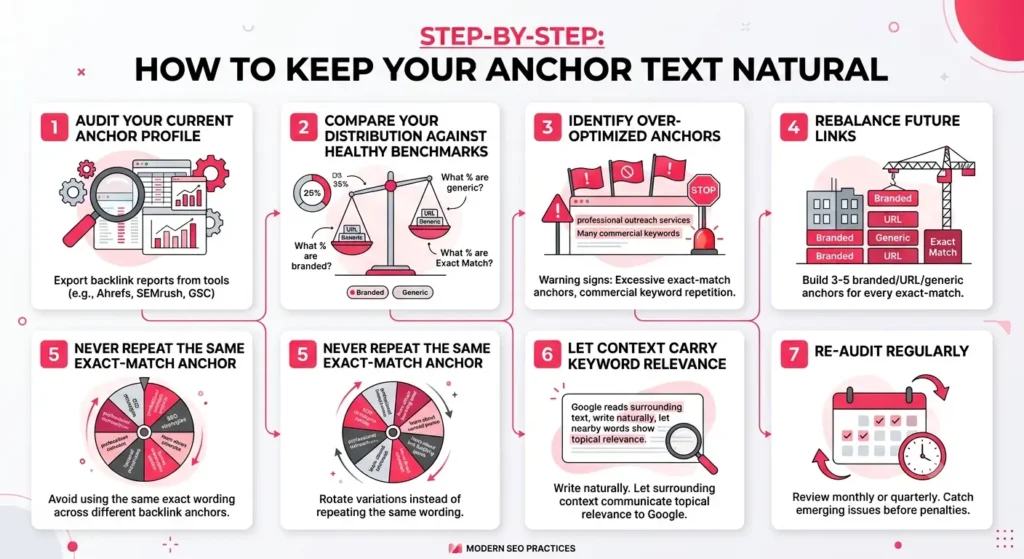
Step 1: Audit Your Current Anchor Profile
Export your backlink anchor report from a tool such as Ahrefs, SEMrush, or Google Search Console. These reports categorize every backlink by anchor text, making it easy to see how often each type appears. Without an audit, you’re building links blind.
Step 2: Compare Your Distribution Against Healthy Benchmarks
Calculate the percentage of each anchor category and ask:
- What percentage of links are branded?
- How many use exact-match keywords?
- Are generic anchors underrepresented?
- Is one keyword appearing repeatedly?
Step 3: Identify Over-Optimized Anchors
Exact-match over-optimization is the most common problem. Warning signs include:
- More than 10% exact-match anchors overall
- One commercial keyword repeated across many referring domains
- Multiple backlinks using identical wording
Prioritize correcting these first — they’re the biggest red flag in an audit.
Step 4: Rebalance Future Links
Rather than removing existing backlinks, adjust the ratio going forward. Prioritize earning links that use your brand name, your URL, generic phrases, and natural descriptive wording. A practical rule of thumb: build three to five branded, URL, or generic anchors for every exact-match anchor you acquire. Over time, this dilutes over-optimized sections of your profile.
Step 5: Never Repeat the Same Exact-Match Anchor
Even when multiple links point to the same page, avoid identical anchor text every time.
Instead of repeating “Get Rank Fast” across every link, rotate variations: “Get Rank Fast,” “professional outreach services,” “how to get rank fast guide,” “learn about outreach,” “SEO outreach strategies.” Dozens of identical anchors from different publishers is not something that happens naturally — variety is what makes a profile look authentic.
Step 6: Let Context Carry Keyword Relevance
Google reads the surrounding paragraph, not just the anchor text itself. Rather than forcing keywords into every anchor, write naturally and let nearby words reinforce relevance. Instead of anchoring the exact phrase “Get Rank Fast,” you might write: “Our guide explains in detail how professional outreach helps businesses earn authoritative backlinks” — with the anchor sitting naturally inside that sentence. The context communicates topical relevance while the anchor itself stays natural.
Step 7: Re-Audit Regularly
Anchor distribution shifts as you earn new backlinks. Review monthly if you’re actively building links, or quarterly for slower campaigns. Regular audits catch emerging issues before they become penalty risks.
Common Mistakes That Break Natural Distribution
Even experienced SEO professionals sometimes create unnatural anchor patterns without realizing it.
Overusing exact-match anchors on money pages. Commercial landing pages are especially vulnerable to over-optimization. If nearly every backlink uses the target keyword, the pattern becomes obvious to Google’s algorithms. Keep exact-match anchors limited and reserved for your highest-quality editorial placements.
Reusing the same anchor across multiple links. Repeated anchor text is one of the clearest signals of coordinated link building. Rotate between branded, partial-match, descriptive, and generic anchors — diversity always reads as more natural.
Ignoring internal link anchors. External backlinks aren’t the only anchors Google evaluates — internal linking contributes to your site’s optimization signals too. Using the same internal anchor repeatedly can reinforce over-optimization, so vary internal anchors just as you would external ones.
Buying links with pre-written exact anchors. Many paid link services ask clients to supply exact anchor text. Repeating the same commercial phrase across dozens of purchased links creates an artificial footprint. If you purchase editorial placements, push for natural anchor variation instead of insisting on exact-match keywords.
How to Fix an Already Unnatural Profile
An over-optimized anchor profile doesn’t necessarily require removing hundreds of backlinks. Most of the time, the fix is a gradual rebalancing.
Build more branded and generic links. For the next several months, focus almost exclusively on branded anchors, naked URLs, and generic phrases. These “offset” links gradually dilute excessive keyword usage and restore a healthier ratio.
Use Google’s Disavow Tool only when necessary. Disavowing is a last resort, reserved for clearly spammy, manipulative, or irrelevant links that can’t be removed manually. In many cases, Google’s systems simply ignore low-quality links rather than penalizing the site for them.
Be patient. Anchor profile recovery isn’t immediate. Improvements may begin within a few weeks, but meaningful recovery often takes 6–12 weeks or longer, depending on crawl frequency, link acquisition pace, and overall site authority. Consistency matters more than speed.
FAQs
Quick Recap
- Audit your current anchor distribution.
- Compare it against natural benchmarks.
- Limit exact-match anchors.
- Prioritize branded, URL, and generic anchors.
- Never repeat identical anchor text unnecessarily.
- Let surrounding content reinforce keyword relevance.
- Review your profile monthly or quarterly.
- Correct imbalances gradually instead of making drastic changes.
Conclusion
Anchor text optimization is no longer about inserting the perfect keyword into every backlink. Today’s search engines reward diversity, context, and authenticity — and the key is avoiding repetition. A natural anchor text distribution reflects how real people link: mostly with brand names, URLs, and descriptive phrases, with only occasional keyword-rich anchors.
By auditing your backlink profile regularly, monitoring your anchor ratios, and prioritizing branded and contextual links over exact-match keywords, you can build a link profile that supports long-term rankings while minimizing the risk of algorithmic penalties. Focus on the overall pattern your backlink profile creates — over time, that balanced, editorial-looking distribution contributes far more to sustainable SEO success than chasing a handful of keyword-heavy links.

2 Comments