
One of the most effective strategies to enhance your search visibility is building backlinks, but not all backlinks are equal. The most valuable backlinks are those from real websites that link to your content because of its usefulness, relevance, and, of course, reliability.
In fact, many websites owners choose to build backlinks naturally rather than relying on shortcuts. Manual link building is more time-consuming; however, it allows you greater control over quality and long-term results.
If you prefer to create backlinks on your own, the process should be well-organized and carefully planned. Remember that you are not just building links. You are creating opportunities for other sites to talk about your brand, including quoting your content or sharing your experience.
This is what sustainable link building is all about. This article focuses on manually building links for your website.
What Does It Mean to Build Backlinks Manually?
Manual link building is all about understanding three or four key factors. It involves identifying relevant websites for your own, determining where links are possible, and reaching out to providers to secure a backlink.
This is typically a research, outreach, content creation, and relationship-building process. Essentially, it’s a white-hat approach, focused on creating real value, not spam or automation.
Search engines view backlinks as indicators of credibility. If high-quality sites link to your page, search engines will recognize its value and rank it accordingly. Hand-built link building is important because it enables you to build links on the right websites, not just any website.
How to Build Backlinks Manually Step by Step
Enough talk about the significance of building backlinks manually. Now, let’s head to the crucial steps you need to take to do that successfully.
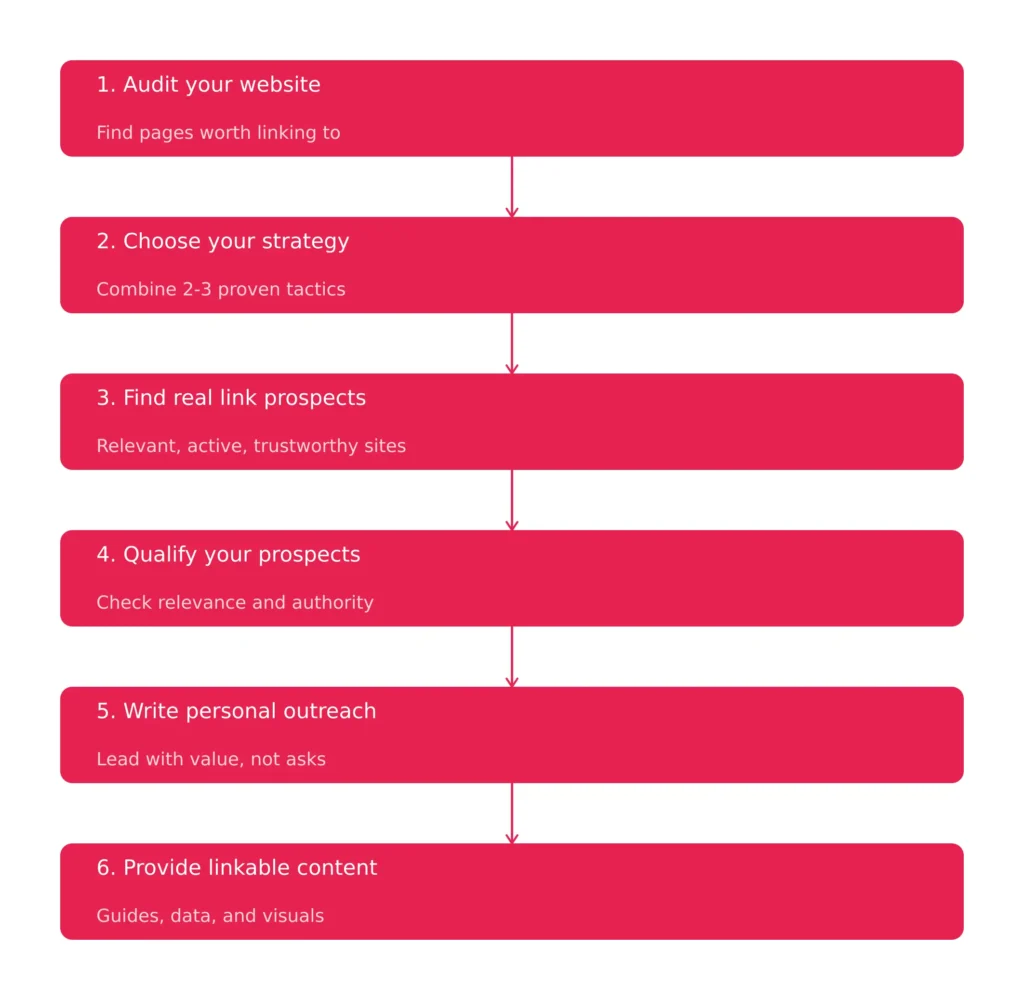
Step 1: Audit Your Website and Find Linkable Assets
The first step in manual backlink building is to examine your website thoroughly. To approach anyone, you must know what you’re promoting. A “linkable asset” is a page or resource that other sites would consider linking to.
This can be a detailed guide, a data study, an original tool, a case study, an infographic, or a good how-to article.
Identify the Website pages that are attracting traffic.
The first step is to decide which of your pages are already getting traffic, engagement, or links. These pages are easier to market because there is evidence of value.
After you’ve done that, check out the competition. Which page(s) of theirs are linked? What are the issues that are of interest for your niche? This can give you an idea of what type of content people are instinctively going to refer to.
The goal is to link to the Sellable pages of your Website
Your objective is to identify pages on your site that are worth linking to from another site. If you do not have strong content yet, that should come before outreach. Good links usually begin with good content.
Step 2: Choose the Right Manual Link Building Strategy
Once you have ticked all the boxes in step one, the next objective is to combine multiple link-building strategies to make them more effective manually.
You don’t have to pursue all of the methods, but using two or three together will often get better results than using just a single method.
The Link Building Strategies You Can opt for
The best handbook link-building strategies are broken-link building, guest posting, white link building, resource-page outreach, unlinked brand-mention reclamation, HARO-style journalist outreach, testimonials, local citations, and niche community involvement. Each technique has its pros and cons.
Guest posting can be a good option when you can create a helpful article for another site and include a link to your article. Broken link building is viable when you identify broken links on a website and recommend your page as an alternative.
Outreach on Resource pages is helpful if the site already has a page with resources that may be of help, and your content fits well with the topic. Links can also be naturally obtained through testimonials and brand mentions.
The best way to do it is to select methods that suit your niche, content quality, and the time you can devote.
Step 3: Find Real Link Prospects
Once you know the kind of product or service you’re promoting, you need to find the appropriate websites. The starting point for prospecting. The best prospect is a website that is relevant, active, trustworthy, and appreciates your content.
Google search operators can help you find opportunities more quickly. Examples of these search terms include “write for us”, “guest post”, “inurl: resources”, or combinations of search terms according to niche.
There are other ways, like searching for / look up competitors in the article, or looking up brands in the article that your site may be a fit for.
Research About Your Competitor’s Backlinking Approach
It’s also beneficial to conduct competitor backlink research. If you are linked to similar sites by some blogs, directories, or publications, you might be linked to them as well.
This is one of the most useful methods for creating a prospect list, since it is not a random shot in the dark but is based on proven link patterns.
Note Down Everything
When collecting prospects, ensure that they are stored in a spreadsheet or CRM. Write down the name of the site, who is responsible for it, who to contact, the subject matter of the site, and why it is relevant.
In the outreach stage, the easier it is, the more organized your list will be.
Step 4: Qualify Prospects Before You Reach Out
Not all websites are worth your time. The good manual link-building process is a qualified one. You don’t want to invest your time and effort in poor opportunities.
Make sure that the site is relevant to your topic. Relevance is important because links may not be as meaningful from websites that don’t relate to your niche.
How to Do it?
Look for any signs of a real, active site as well. It’s best not to focus on it if it lacks good content, has little to no traffic, or shows obvious spam indicators.
There are other indicators of authority and trust to consider as well. A decent, reputable site with a regular blog will generally be more useful than one that only offers link selling. This is part of the reason manual link building is better than automated link building.
Step 5: Make a Personal Outreach Message
Many manual link building campaigns are successful or unsuccessful depending on their outreach efforts. A typical email ends up in the junk folder. Your personalized email will get a much better response.
Your message should be concise, courteous, and to the point. Refer to a page, article, or resource on their site that you found truly interesting. Next, describe how the content you have created could be beneficial to their audience.
It is about value, because that is what is really wanted; it is NOT about a backlink.
Your Outreach Motto Must Have These:
A successful outreach message should quickly address three questions: who you are, your reason for reaching out, and the value your message has for them. Maintain the natural style of the voice. Don’t use cliches or give superficial compliments. Copy-and-paste emails often come across as inauthentic.
Send a follow-up if you don’t receive a response within a few days. It may take more than one email to link build manually. A gracious follow-on message can make all the difference, particularly if you’re leaving a message or it was lost or forgotten.
Step 6: Provide Content for Easy Linking
The most effective way to build backlinks manually is to make it easy to place them. That typically involves a value-added, complete, and convenient resource that the audience can use for reference later.
It could be a guest post, a robust blog post, a distinctive statistic, a research overview, a visual resource, or a resource missing from their site. If your content is more practical, it’s easier for another website to say yes.
How to Find Links:
Links are often more likely to be obtained through original research and data-based information. Ultimate guides are also effective as they will go into detail about a topic. Infographics and visual content can be effective as they are easy to share and embed.
The focus is to develop something that feels genuinely for the aid of others, rather than a marketing tool.
Best Practices for Manual Backlink Building
If you want better results, you must stick to the following principles. It’s better to have a few relevant than a lot of irrelevant. It’s better to have one solid backlink than numerous weak ones. It’s about more than the number of copies.
The quality of the email is better than a mass blast, but it is more likely to be a smaller quantity of thoughtful emails.
Consistency also matters. Manual link building takes time, but it is more effective when done regularly. The key is that if you get some good prospects every week, it will add up to a good campaign over time.
It’s also essential to have tracking. Record your contacts, responses, earned links, and which methods proved most effective.
Conclusion
The manual technique of building backlinks involves creating quality content, finding the right people to link to, sending them a personalized message, and persistence.
Think about the need to be relevant, trusted, and useful in all aspects. That’s why manual link building is no longer a tedious task but a real growth strategy.
This is the natural way of doing business at manuallinks.io, since building links manually, when done properly, is an effective link-building method.
We can be a part of your most successful SEO strategy if you remain consistent with your efforts, keep links personal, and continually improve your content.

One Comment