
If you’ve searched “buy backlinks” recently, you’ve probably noticed something: every article is the same. A “best places to buy backlinks” listicle, ranking the same ten marketplaces, with the same pricing tables.
Nobody’s actually telling you why that matters, or what’s happening behind the scenes when you buy from one of those platforms.
Short answer: buying backlinks in 2026 still works, but where and how you buy them matters more than it did two years ago. Here’s what the other guides aren’t telling you.
Backlinks are still the fastest and safest methods to rank in the search engine results and generate steady organic traffic.
Backlinks from high-authority websites can help you rank in AIO and GEO, along with SEO benefits, which means building backlinks is not yet out of the race, but the quality should remain excellent.
When done wrong, it can result in a Google manual punishment that is difficult to overcome and sometimes takes months to recover from.
This guide provides all the facts you need to make a wise, informed backlink purchase.
What Does “Buying Backlinks” Actually Mean?
Buying backlinks means paying a site owner, editor, or agency so that another website links back to yours. It can take the form of a sponsored guest post, a niche edit (a link inserted into existing content), or a flat placement fee paid to a marketplace. The one thing that separates it from earning a link is simple: money changed hands to make the link exist.
| Quick answer | Buying backlinks means paying for a link placement — via a guest post, niche edit, or marketplace fee — instead of earning it editorially. |
| Is it against Google’s rules? | Only when it’s undisclosed and done purely to manipulate rankings. Google requires rel=”sponsored” or rel=”nofollow” on paid links. |
| Typical cost in 2026 | $50–$3,000+ per link, depending on Domain Rating and placement type (full breakdown below). |
| Safer alternative | Manual outreach for editorial placements, or earning links through content worth citing. |
Why Businesses Still Buy Backlinks in 2026
Let’s start off by answering the glaring question first. With Google’s algorithm more sophisticated than ever and AI-powered search changing how results are served, is buying backlinks still relevant?
The statistics indicate yes, by a very big factor.
An Editorial 2025 industry survey surveyed more than 500 SEO experts. The outcome: 91.9% of the participants feel that their immediate rivals are vigorously purchasing backlinks. That number is divided among in-house SEO, freelancers, and agency professionals. It is not a specialty practice; competitive search visibility is the order of the day.
The reasoning is the same. Google sees the backlinks as votes of confidence between two websites. An outbound link on a high-authority, niche-relevant site will indicate to search engines that your content is credible and worthy of ranking. The more valid such votes, the higher you are in search results.
So, What Does it tell?
The quality bar has changed. Google 2023-2025 algorithm updates, especially the Helpful Content system updates, wiped out thousands of low-quality sites of link vendors. The number of truly safe, traffic-bearing placement sites declined. The surviving sites are more expensive. The quality backlink marketplace is now more competitive, smaller, and more costly compared to three years ago.
The understanding of this context is the initial step towards using your link-building budget judiciously.
How Much Does It Cost to Buy Backlinks in 2026?
The cost of backlinks in 2026 can be by far different, based on the site authority, niche, type of placement, and model of the provider. Below is the true breakdown of current market rates.
Included Cost per Domain Rating
| Domain Rating | Average Cost per Link | Risk Level | Best For |
| DR 10 – 29 | $50 – $150 | Moderate to High | Foundation diversity only |
| DR 30 – 49 | $150 – $400 | Low to Moderate | Growing sites, moderate competition |
| DR 50 – 69 | $400 – $900 | Low | Competitive niches, authority building |
| DR 70+ | $900 – $3,000+ | Very Low | Enterprise brands, high-stakes keywords |
Cost by Link Type
| Link Type | Average Cost | What You Get |
| Link Insertion / Niche Edit | $100 – $450 | Your link placed in existing ranked content |
| Guest Post — Mid Tier (DR 30–50) | $200 – $600 | Original article written and published on a third-party site |
| Guest Post — High Authority (DR 50+) | $600 – $2,000 | Premium editorial placement on established publication |
| Digital PR Link | $1,000 – $2,500 per link | Earned editorial coverage from outreach campaigns |
Pricing by Agency Retainer (Monthly)
| Package Tier | Monthly Budget | Links Delivered | Best Suited For |
| Starter / Growth | $500 – $1,500 | 4 – 10 links | New sites, low competition niches |
| Mid-Market | $1,500 – $3,500 | 8 – 16 links | E-commerce, SaaS, growing brands |
| Authority / Competitive | $2,500 – $6,000 | 14 – 25 links | Established brands in competitive niches |
| Enterprise | $6,000 – $15,000+ | 25 – 60+ links | Market leaders, high-value keywords |
The 3 Models for Buying Backlinks — And What Each Delivers
Three radically different approaches will be available when you enter the backlink market. Knowing each other helps you in aligning the proper model with your objectives.
| Model | Speed | Control | Best For |
| Self-Service Marketplace | Fast | Low — pick from existing inventory | Experienced SEOs vetting sites themselves |
| Managed Agency | Moderate | High — briefed and approved by you | Business owners who want it handled safely |
| Monthly Retainer | Steady | Moderate — predictable but less custom | Brands needing continuous link velocity |
1. Self-Service Marketplaces
Platforms like INSERT.LINK and PressWhiz are marketplaces. You open an account, view possible placements filtered by criteria such as Domain Rating and organic traffic, and buy the ones that align with your campaign.
Advantages
Speed and transparency. You can view the page metrics and the location, and then commit. No need to make any outreach on your part.
Cons
You will choose from an existing list of sites that have already agreed to sell links. These locations are familiar to search engines in the long term, especially through link analysis.
On the same platform, there is significant quality variance. You are left to vet each placement.
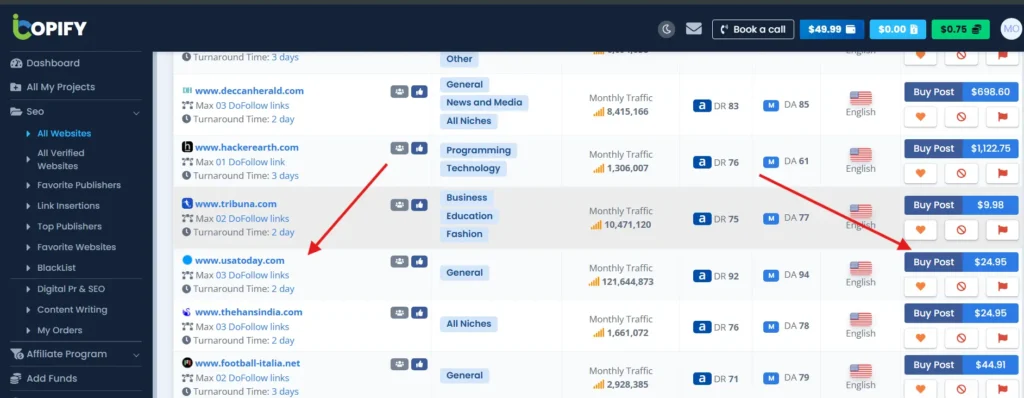
Sometimes, I feel these types of marketplaces are scammy. For Testing, I searched for a USA Today placement and found one for only $24.95 with 3 dofollow links. Do you believe it? You can see in the screenshot below.
Best: Experienced SEOs who can judge the quality of sites on their own and require quick, self-directed placements.
2. Managed Agency Services
The agencies deal with prospecting, outreach, content creation, and placement. You brief the campaign, sanction targets, and get live connections.
In this model, two sub-categories can be distinguished:
Software is used in automated or AI-guided agencies to determine the sites of placement and scale the volume of outreach. They are able to travel fast and at reduced per-link cost. The trade-off is an increased ratio of placements on sites with bloated metrics, compromised traffic, or link network footprints.
Manual outreach agencies, such as Manual Links, establish all the links by actual human interaction with actual website owners. Each site is checked separately in regard to the quality of traffic, editorial quality, and relevance to the niche before pitching is done.
It is a bit more costly and slower, but generates links that are much more difficult to detect by Google as paid placements and much more likely to endure algorithmic changes.
Best Use: Agency owners and business owners who desire a safe and steady link-building, but do not want to do it in-house.
3. Monthly Retainer Packages
The services based on subscriptions will provide a certain number of links each month at a certain price. You are aware of your budget and rough production beforehand.
Pros
Budget predictability. Uninterrupted link velocity, which is significant in appearing natural to the search engines.
Cons
Quality is more difficult to scale. Other subscription services are more concerned about achieving the number of links than finding really good placements.
Best in: Brands that require continuous acquisition of links as opposed to project-based management.
Why Buying From the Same Marketplace as Your Competitors Is Risky
Here’s something almost nobody talks about directly: when you buy through a large marketplace, you’re very likely buying from the same pool of sites your competitors — and thousands of other unrelated businesses — are also buying from.
Marketplaces work by building an inventory of publisher sites and reselling placements on them to whoever pays. That’s efficient for the marketplace, but it means a single site might carry outbound links to dozens of unrelated businesses within a short window, all sold through the same channel.
Search engines are increasingly good at spotting these patterns — a site that suddenly links out to twelve different SEO tools, three CBD brands, and five SaaS products within a month doesn’t look like organic editorial coverage, because it isn’t.
This doesn’t mean marketplaces are useless. It means the safest way to use one is to check whether a site has visibly diverse outbound links already (a sign it’s genuinely selective) rather than assuming a slick-looking marketplace interface equals quality control. The providers worth paying for are the ones with real relationships to individual publishers — not just a shared inventory everyone taps into.
How to Evaluate a Backlink Provider: A Quick Checklist
Before you pay anyone, run them through this checklist. A provider that fails more than one or two of these is worth walking away from.
- They show you the actual site before you pay — not just a metrics screenshot, the live URL and where your link will sit.
- Traffic matches the metrics — cross-check organic traffic in Ahrefs or Semrush; a high DR with near-zero real traffic is a red flag on its own.
- They accept and disclose
rel="sponsored"orrel="nofollow"where Google’s guidelines call for it, rather than insisting on a “guaranteed dofollow” link. - Anchor text is your choice, within reason — a provider pushing exact-match commercial anchors on every order is optimizing for a penalty, not for you.
- The site’s outbound links look diverse — a quick check of who else the site links to tells you whether it’s genuinely editorial or just selling slots.
- Pricing is realistic for the authority offered — see the cost tables above; a DR 50+ site selling links for $30 is not what it appears to be.
The Red Flags That Signal Dangerous Backlink Providers
With the number of bad providers in the market, it is important to identify the red flags before you part with money.
1. Private Blog Networks (PBNs):
Sites that are created or purchased and are designed to sell links only. They frequently possess overvalued DR scores, small actual traffic, and the same ownership fingerprints.
The spam detection by Google has become so efficient in detecting and deindexing PBN clusters. Outbound links have a high risk of penalties. These types of links you will mostly find on Black Hat World forum.
2. Link farms
Websites that take any content and any link without editorial standards. Typical price: $10 to $50. Common execution: nothing gained, and possibly a bad effect on the trust signal of your domain.
3. Precise match anchor spam
This is done by providers who use the same keyword-stuffed anchor text on all links they generate, leaving an unnatural footprint that manual reviewers and algorithms easily detect. See our guide on natural anchor text distribution for the healthy ratios to insist on from any provider.
Guaranteed placement packages that lack transparency of the site: When a provider is not able to demonstrate to you the exact sites that they will post your links on prior to you providing any payment, they are likely placing links on networks that they do not want you to analyze.
Less than $100 per link in high-authority sites: A DR 50+ site with actual organic traffic can be charged real money since it has real editorial value. A DR 50+ site that sells links at $30 is either a PBN or a compromised site with fake numbers.
A few more warning signs worth scanning for before you order, drawn from patterns across the industry — see our full breakdown of white hat vs. grey hat vs. black hat SEO for where each one sits on the risk spectrum:
| Red Flag | Why It’s Dangerous |
| “500 backlinks for $99” bulk packages | Mathematically impossible to be quality at that price — near-certain spam |
| Guaranteed specific rankings | No provider controls Google’s algorithm; this is a sales tactic, not a service |
| “100 links in 24 hours” | Real editorial placements take review time; instant delivery means automation or PBNs |
| Links from unrelated niches | A payday-loan site linking to a yoga studio reads as manipulation, not endorsement |
| Hidden anchor text (footers, sidebars, CSS-hidden) | Built to be invisible to readers — a clear manipulation signal to Google |
| No visibility into sites before payment | If they won’t show you where your link lands, they don’t want it examined |
The reason why Manual Outreach yields better links than Automated Systems is:
The gap between links created by actual manual outreach and those created by automated or semi-automated platforms extends beyond the ethical consideration – it manifests itself right in the ranking performance and longevity.
Manual outreach means that a real individual is calling a real website owner, pitching an idea of content that would fit well with their audience, and securing a placement via an actual editorial relationship. The subsequent connection is in the content that is on that site. It feels natural, as the procedure was natural.
Automated outreach is where templated messages are delivered by software to lists of sites that have expressed interest in selling links. The resulting placements tend to have discernible algorithms – like structures of similar content, similar types of anchors, similar site profiles – that machine learning systems at Google are becoming more and more capable of detecting.
Google does not simply disregard paid link patterns when they are spotted. It undermines them, puts them under manual review, and when done systematically, imposes penalties that strip rankings altogether.
The agencies and businesses that have preserved their positions and expanded their rankings with three years of significant algorithm changes have one thing in common, namely, they established links on the basis of genuine relationships with genuine websites, rather than platforms that increased their outreach into an industrial procedure.
Do Backlinks Still Matter for AI Search Visibility in 2026?
Yes, Backlinks are becoming more and more a factor in whether AI tools like ChatGPT, Perplexity, and Google’s AI Overviews cite your business as a source, not just in traditional Google rankings.
This is the part most 2026 guides leave out. AI search tools don’t just crawl the web like traditional search engines but rely heavily on signals of authority and consensus to decide what to cite and summarize. A firm that’s been cited and linked to by several relevant, independent sources looks more “real” to these systems than one with no third-party footprint at all, even if its own website content is superb.
In practical terms, that means backlinks are no longer just an SEO play — they’re increasingly a visibility play across AI-driven response engines too. A relevant guest post or press mention doesn’t just help you rank; it becomes one more data piece that an AI model might pull from when a user asks it a question your firm could answer. This is a truly new reason to buy into real, relevant placements over volume-based marketplace links — AI systems tend to reward quality and consistency over pure link count.
Buying vs. Earning Backlinks: Which Should You Actually Do?
Most healthy backlink profiles aren’t purely one or the other — they blend both. But the two approaches solve different problems, and knowing which one fits your situation saves budget.
| Factor | Buying Backlinks | Earning Backlinks |
| Speed to first links | Days to weeks | Weeks to months |
| Upfront cost | Direct placement fees | Content and promotion time/cost |
| Compliance requirement | Must disclose (rel="sponsored"/nofollow) | None — links are voluntary |
| Long-term risk | Medium — depends entirely on provider quality | Very low |
| Best for | Filling gaps quickly, competitive keywords with a deadline | Durable authority that compounds without ongoing spend |
If you’re weighing the second column seriously, our guide on how to earn links naturally covers the 10 strategies — original research, statistics pages, digital PR, and more — that consistently earn links without a placement fee attached. Most of the businesses that hold their rankings through algorithm updates are running both playbooks at once: buying selectively for speed, earning continuously for durability.
Setting Your Buy Backlinks Budget in 2026
To decide on the amount of money to spend, it is important to be honest in terms of where you are and what you require to achieve your desired situation.
Step 1- Specify your gap in links.
Go to Ahrefs or Semrush to check the number of referring domains of the 3 highest ranking pages of your target keyword.
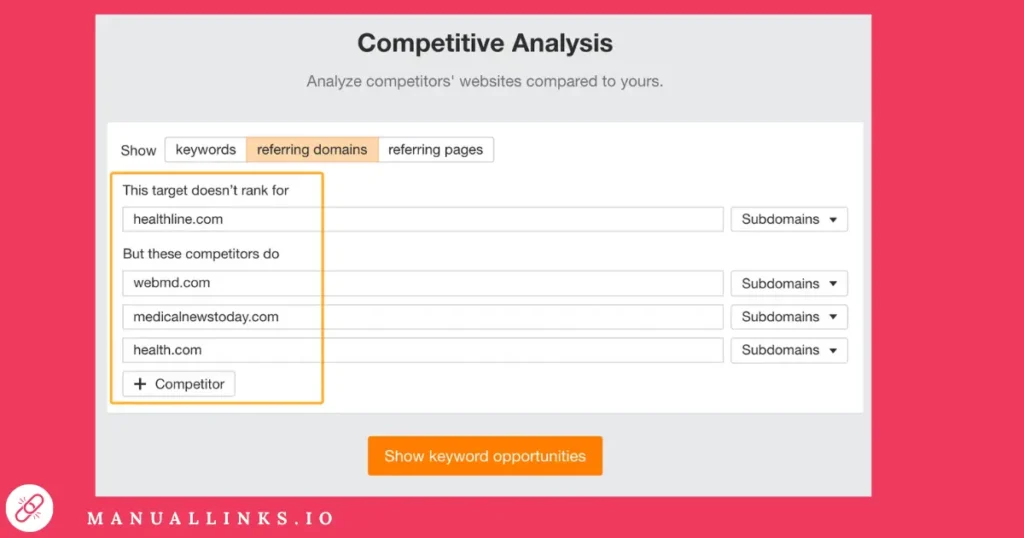
The difference between their number of domains and yours is an approximate measure of the volume of links they must have to be competitive.
Step 2 — Calculate keyword value
Assuming that being ranked in the first position on your keyword can earn your company 20,000 per month, a 3,000 monthly link-building budget will be clearly and defensibly justified in terms of ROI.
Assuming that the keyword has an income of $800 a month, then calibrate.
Step 3 — Be consistent rather than burst
Speed of linking – how quickly you gain new links is important to the search engines. Constructing 40 connections in a month and having none of the following does not seem natural and builds ranking volatility.
Consistent monthly spending has a longer-lasting effect than sporadic heavy expenditure.
Business type budget guidelines:
Local or small business in a low competition niche: $500 – $1,500 per month. Target 4-8 niche-relevant placements on mid-authority websites.
E-commerce or SaaS in moderate competition: $1,500 – $3,500 per month. Purchase DR 40-60 editorial placements in industry publications.
Established brand within competitive niche: $3,000 -6,000 per month. Target DR 50+ and strategic anchor diversification and competitor gap analysis.
Enterprise that is competing on high-volume commercial keywords: 6000-15000+ per month. Needs a full-service manual outreach campaign and account management.
Staying Compliant: Paid Link Disclosure Rules
Buying a backlink isn’t against Google’s guidelines by itself — not disclosing it is. Google’s own link spam policy requires that paid links be marked so they don’t pass ranking credit silently.
| Situation | How to Tag It |
| You paid for a guest post or placement | rel="sponsored" |
| You’d rather not disclose the commercial relationship publicly | rel="nofollow" |
| A provider insists on a plain, followed link in exchange for payment | Decline — this is the exact pattern Google’s spam policy targets |
| A link was earned editorially, no payment involved | Normal followed link — no tag needed |
If a provider won’t agree to proper tagging, that’s a negotiating position worth having before you pay — and it pairs with everything above in the evaluation checklist. For the outreach-driven, disclosure-free alternative, see our complete guide to manual link building.
FAQs
Conclusion
The idea of buying backlinks does not just depend on whether we find the lowest cost supplier or the maximum DR. It is about finding links that will still be working in a year or so to come.
These links come from real websites with actual readers, links that have found their way into the genuinely useful material, connections that have been obtained by way of actual conversation with the owners of websites.
In 2026, that means:
- Selecting providers that will present you with traffic information prior to making a purchase.
- Focusing on niche relevance instead of domain authority.
- You should not take any service that does not describe the location and placement of your link precisely.
- Making a commitment to a steady amount of purchases every month instead of a single purchase.
- Manual team building (not at an automated scale).
- Agencies and business owners who gain the highest returns on link building are not the ones who incur the highest expenses. It is they who are spending it most carefully, on fewer, better links to those websites that do make a difference in their industry.
That is the norm to be within in 2026. And it is the standard that distinguishes between the link building that compounds in value and the link building that evaporates when the next algorithm update comes.

2 Comments